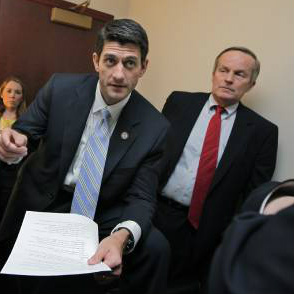
Steve King, a thug who manhandled Martha Mitchell to keep her from talking to the press about Watergate, took the stage at the Republican National Convention to nominate his buddy Paul Ryan.

It was just another moment in the spotlight for Wisconsin, according to the
Milwaukee Journal Sentinel, which spends full-time promoting Paul Ryan these days. This is just one of two stories about King's role, both by longtime political reporter Craig Gilbert, who's been around long enough to know King's story.
Paul Ryan’s name will be placed in nomination for vice president Tuesday by Wisconsin’s Steve King, a longtime friend and a member of the Republican National Committee. [That's him pictured in an old photo. He seems to stay away from photographers.]
“Essentially, we’re trying to introduce Paul to the world,” said King. “It’s my three and half minutes … I’m going to try to personalize it.”
King, 71, and Ryan go back to before Ryan’s time in Congress. Paul Ryan volunteered on King’s unsuccessful campaign for U.S. Senate in 1988.
“He was an envelope stuffer,” says King.
And King has chaired all of Ryan’s House races (Ryan was elected to Congress in 1998). King is a former state chairman of the Wisconsin GOP, and a former business associate of Ryan’s brother, Tobin.
And now, the rest of the story (apologies to Paul Harvey, wherever he is):
King was deeply involved in helping Richard Nixon cover up the Watergate scandal during the 1972
presidential campaign, Martha Mitchell's biography says. King, a former Wisconsin
Republican Party chair, ran for the US Senate in 1988.
King, an ex-FBI
agent, was working as a security man for the Committee to Reelect the President,
known as CREEP, in 1972. He was assigned as personal security escort for former
Atty. Gen. John Mitchell, the head of CREEP, and his outspoken wife, Martha,
when the Watergate burglary became public. King later became head of security
for CREEP, replacing his boss, John McCord, who was one of the Watergate
burglars who broke into the Democratic Party's national headquarters.
The Mitchells were in California when the break-in occurred, but John
Mitchell soon left for Washington to deal with the crisis, leaving Martha and
King in California. When Martha was unable to reach him by telephone the next
two days, the biography says:
Periodically, she'd go tell Steve King and Lea Jablonsky (John
Mitchell's secretary) about the dirty tricks she knew had been instigated by the
Nixon Administration and the Committee (CREEP), hoping to learn more from
them.
She wanted her husband to quit CREEP and get out of politics
and left that message with a Mitchell aide in DC. She also told the aide she was
going to call the press and tell them about her ultimatum to John. She called
Helen Thomas of UPI and was telling her about her disgust with politics when,
she said:
Steve King rushed into her bedroom, threw her back across the bed,
and ripped the telephone out of the wall.
She tried to call from
another room:
Again, she said, she was thrown aside while the phone was
disconnected. Steve then shoved her into her room and slammed the
door.
She tried to climb from the balcony in her villa to the one
next door, but
Steve King ran out and pulled her back inside. She claimed he threw
her down and kicked her.
King stood guard outside her door. The
Nixon and CREEP people began to spread stories that Martha was crazy, an
out-of-control alcoholic, or had had a breakdown. The next day
...King was no longer guarding her door. She slipped downstairs,
planning to escape, but King spotted her just as she reached a glass door. In
the ensuing scuffle, Martha's left hand was cut, so badly that six stitches were
required in two fingers.
When a doctor came to treat her hand, she
was highly agitated and, with the help of two or three security people, he
injected her with a sedative as she resisted. Before it took effect, she tried
to get away, but
According to Martha, King saw her dashing toward the door and ran
over and slapped her across the room.
Martha left the next day,
agreeing to stay with friends in New York state, but instead checked into the
Westchester NY Country Club and called UPI to say she had been held a political
prisoner in California. When the story moved on the wire, reporters swarmed the
country club, but only a
NY Daily News crime reporter, Marcia Kramer,
got into to see Martha.
As a crime reporter, Marcia says it was her opinion that Martha was
a "beaten woman" and that the "incredible" black and blue marks on Martha's arms
looked like they were a "totally professional job."
Martha
eventually agreed to rejoin John in Washington, on condition that he resign from
CREEP and that King and Jablonsky be fired. Mitchell resigned, but Martha found
out later that rather than firing King, one of the last things Mitchell did at
CREEP was to promote King to head of security -- presumably for a job well done.
A few months later, in a letter to Parade magazine, a national Sunday newspaper
supplement, Martha told columnist Walter Scott that:
Steve King ... "not only dealt me the most horrible experience I
have ever had, but inflicted bodily harm upon me."
King, no doubt,
will dismiss all of Martha's claims as untrue, the ravings of a drunken lunatic.
But Winzola McClendon, who authored the biography, tells of a conversation she
had later with John Mitchell, in April 1973:
We discussed the California incident. I asked if Martha really had
been held down and sedated, and he said everything she told me was "essentially
true." Why did Steve King and Lea Jablonsky -- a young woman Martha considered
her friend -- let this happen? "These kids were scared to death ...They thought
they were protecting me," he answered.
After Nixon won the election,
King was rewarded with a job as special assistant to the Secretary of
Agriculture, Earl Butz. That, of course, was before it all came tumbling down
and Nixon was forced out of office on Aug. 8, 1974.
Quotes and excerpts are from Martha: the Life of Martha Mitchell, by Winzola
McLendon, published in 1979 by Random House. Ms. McLendon, a journalist and
White House correspondent, met Martha Mitchell while interviewing her in 1970
and became a friend and confidant while continuing to work as a reporter.